
Notes from the Border. On the exhibition of Latgale artists at the Rothko Museum
This year, the Rothko Museum’s annual exhibition of Latgale artists – curated by Aivars Baranovskis and Tatjana Černova – turns its gaze to the border, both as a line on a map and as a threshold of imagination. On view until 24 May, it brings together creators across generations and media, united by a shared connection to Latgale. In the final weeks of the exhibition’s runtime, we are pleased to share its interpretation by art historian Evija Vasilevska.
When the then-Daugavpils Mark Rothko Art Centre first opened its doors in 2013, it did more than welcome visitors. It ignited a tradition – an annual exhibition of artists from the Latgale region. The inaugural edition, “Untitled No. 2013 – Art Days 2013”, gathered Latgale’s artists in a vibrant conversation with Rothko’s legacy. “We invite all artists of the region to take part,” declared the original open call, and, more than a decade later, the idea remains. That first show rekindled the spirit of the celebrated Latvian Art Days, and from the very beginning, each exhibition embraced a guiding motif. These themes have never boxed artists in. Instead, they have served as sparks – resonating, encouraging, and fuelling creative exploration across every medium.
Over the years, the exhibition’s themes have danced across a spectrum of ideas. Some invited philosophical reflection – like “Desire”, “Legalised Fantasies”, “Forms of Emptiness and Silence” and “No Exception”. Others have been subtle nods to figures rooted in Latgale’s history. “Inside Out” referenced Christopher Rothko’s book about his father, while “Clownery” honoured the Daugavpils-born Coco the Clown, né Nikolai Poliakoff (1900–1974). As the world’s political landscape shifted, the exhibition absorbed these tremors, echoing the realities of conflict in themes such as “When Cannons are Silent”.
The 2026 theme reaches out to Latgale and beyond, foregrounding the idea of borders and borderlands. While we often picture borders as simple dividing lines, the concept stretches much further. Borders can be shaped by history, traced by rivers, or drawn between reality and illusion. They mark the edge of the self and the world, the limits of art, and the boundaries within artistic language itself. In this landscape of ideas, the borderland emerges as a unique in-between – a threshold, a liminal space of possibility and transformation.
The 2026 exhibition opens its arms even wider. Not only does it welcome artists rooted in Latgale, but it also embraces those whose creativity has been sparked by time spent in the region – whether living, working, or simply passing through. This broader vision promises a richer and more nuanced spectrum of perspectives and emotions.
This year, the exhibition brings together more than sixty voices. Beyond classic paintings and prints, visitors can explore installations, sculptures, textiles, ceramics, photographs and artworks that awaken senses beyond sight.
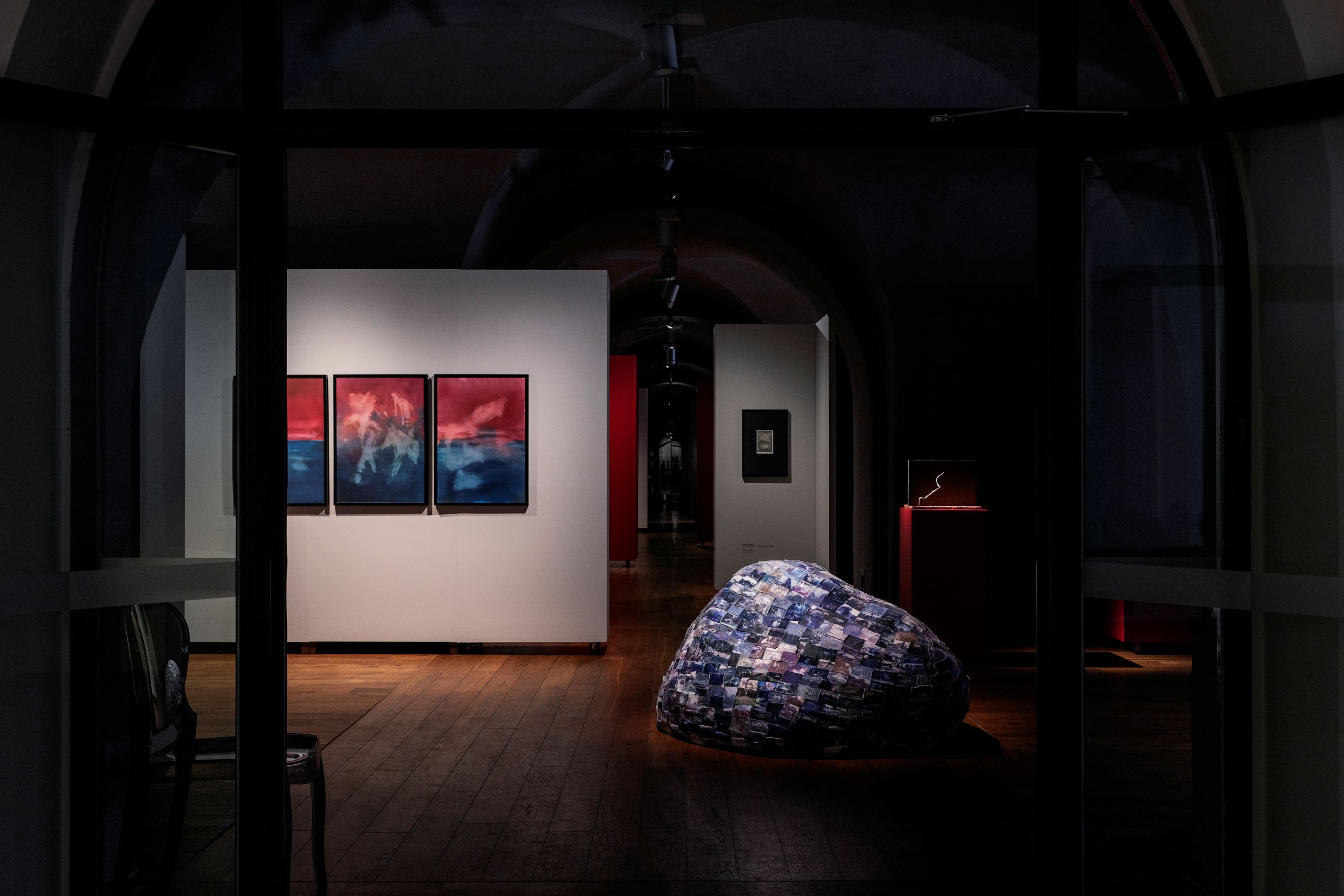
The show unfolds as a spatial experience. At the threshold, visitors are greeted by Terēze Juškus’s “Mega Megalith” (sublimation print on fabric, 2024), a boundary stone that conjures the mystery and gravity of ancient rock formations. Its surface is alive with smaller images, their stories unfolding only to those who pause to look more closely, heeding the piece’s call to contemplate humanity’s enduring presence across time and space.
Amid the turbulence of our times, the exhibition invites moments of quiet reflection. What secrets are hidden in the depths of Prussian blue in Andris Kaļiņins’s painting (“Prussian Blue No. 1”, oil on canvas, 2025), and what echoes of history linger there? What solemn story do the sombre threads of Ingūna Levša’s tapestry (“Heddle”, tapestry, 2025) tell? Why does Alina Petkūne’s “Passage Guardian” (oil on canvas, 2025) resemble neither human nor beast, but rather some hybrid, mythic being? And does the almost black landscape (“Darkness Surrounds You”, oil on canvas, 2026) created by Ilze Griezāne – punctuated by small glimmers of hope – truly speak of nothing but the darkness of war?
In other corners of the exhibition, artists take a lighter approach, inviting viewers to simply revel in the beauty of painted surfaces and artistic expression. Works like Natalia Marinoha’s “Celebration” (mixed media, 2025) and Uldis Čamans’s “Caution” (oil on canvas, 2025) offer pure visual delight, free from narrative burden.
Among the most powerful statements about the harsh realities of Latgale’s borderland is Vika Eksta’s photographic series “Funeral in Sloboda” (silver gelatin prints, 2011–2025). As visitors follow this conceptual border, the exhibition becomes a journey through imagined stories: a homecoming to ancestral roots (Mairita Folkmane, “Delicate Warmth”, porcelain, wool and wood, 2026; Jurika Bakāne, “Soviet Heritage”, oil on canvas, 2024), a table ominously laid for enemies (Kristīne Nicmane, “We Will Not Share a Table”, wheel-thrown and cast porcelain, 2026), the solace of wrapping oneself in woven linen like a mother’s embrace (Annele Slišāne, She Who Is Lost (Enfolded in Grandmother’s Woollen Shawl), knit, 2026) and the fleeting moods of passing hours (Agnese Leikuse & Agnese Birzenberga-Muižniece, “Evanescent Permanence”, photography, poetry, video, 2025). The path through “Borderland” culminates in Aija Bley Cimiņa’s monumental textile, “The Guardian” (textile appliqué, 2025), where a formidable feminine figure stands as a modern-day warrior both mesmerising and unsettling, echoing the totemic power and mystery of ancient matriarchs.
The journey may also end with the words of Mark Rothko himself, who observed that the dramatic and emotional potential of different coloured light, the varying degrees of light and dark, and the contrasts between highlight and deep shadow can evoke a mood even before a word is spoken or any action is taken. He regarded mood or sentiment as introducing the element of humanity into a painting. Ultimately, Rothko saw mood as the subjective factor that, allied with the objective presence of light, produced a new unity of the subjective and the objective, lifting a work of art above the limits of humanity and into a realm of myth.
Evija Vasilevska, Mg. art.
Publicity image: Borderland. Exhibition view (photo by Santa Suhanova)