
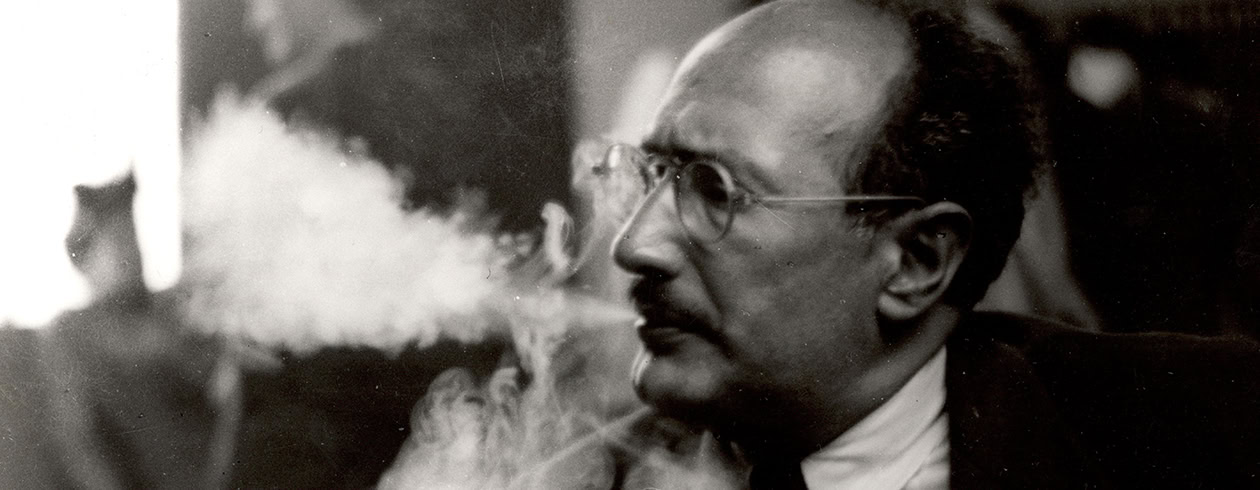
Mark Rothko (1903–1970) was one of the most significant American artists of the 20th century and a leading figure of Abstract Expressionism. He was born on 25 September 1903 in Dvinsk, Russian Empire (now Daugavpils, Latvia), into the family of Jewish pharmacist Jacob Rothkowitz.
At the age of five, Marcus Rothkowitz was sent to a Jewish religious primary school to study the foundations of the Talmud. Mystical Judaism later inspired him to write poetry on Old Testament themes and became one of the sources of inspiration for his artistic practice. In 1913, at the age of ten, he travelled to the United States with his mother and elder sister Sonia, where the family settled in Portland, Oregon.
As one of the top graduates of Lincoln High School, Marcus Rothkowitz received a scholarship to Yale University in 1921. Initially, he considered becoming an engineer or a lawyer, but after two years he moved to New York, where he attended acting classes and studied under Max Weber at the Art Students League from 1924 to 1927.
The works of Paul Cézanne, Max Ernst, Joan Miró and, particularly, Henri Matisse had a profound influence on his artistic development. During the 1920s and 1930s, Rothko produced hundreds of figurative works, depicting nudes, portraits, interiors, urban scenes and landscapes.
In 1940, Marcus Rothkowitz adopted the name Mark Rothko. He became one of the central figures of post-war American painting and, alongside Jackson Pollock, Willem de Kooning, Barnett Newman and Clyfford Still, represented the Abstract Expressionist movement associated with the New York School.
Around 1940, Rothko turned his attention to ancient mythology and depth psychology, reading the works of Friedrich Nietzsche, Carl Gustav Jung and Søren Kierkegaard. For almost a decade, his artistic practice was shaped by Surrealism and themes drawn from ancient tragedies, reflecting his response to the tragic events unfolding in Europe.
By around 1947, Rothko had gradually abandoned figurative elements and developed his distinctive visual language: two or three fields of colour arranged one above another, interacting with each other and the surrounding pictorial space. This reduced yet visually powerful form of expression enabled the artist to evoke profound emotional experiences.
In 1961, the Museum of Modern Art in New York organised a major retrospective of Mark Rothko’s work, which subsequently travelled to several European cities. In 1962, the artist completed a series of murals for Harvard University, and in 1964 he began work on the paintings for the Rothko Chapel in Houston. The chapel opened in 1971, after the artist’s death.
Mark Rothko died on 25 February 1970 in New York. His works are held in the collections of some of the world’s most important art museums and galleries.
Rothko’s Artistic Legacy
Mark Rothko had a profound influence on the development of post-war painting in the United States. Like many artists of his generation, he believed that recognisable imagery could interfere with the direct experience of art. Gradually moving away from figurative painting, Rothko developed abstract compositions based on the interaction of large fields of colour.
His painting explores the expressive potential of colour, the perception of light and space, and the emotional impact of art on the viewer. His seemingly simple compositions can evoke both melancholy and a sense of radiant luminosity, conveying complex ideas that are at once deeply personal and universal.
In 1969, Yale University awarded Rothko an honorary doctorate in fine arts, recognising his significant contribution to the development of a new school of American painting and his influence on generations of artists around the world.
Rothko’s artistic legacy continues to inspire not only visual artists but also composers, writers and poets. His influence can be traced through contemporary painting, music and literature. His works remain central to major international exhibitions, affirming his enduring place in the history of world art.
Rothko in Daugavpils
Mark Rothko, born Marcus Rothkowitz, was the fourth child in the family of Jacob Rothkowitz, a pharmacist in Dvinsk. The family lived on Shosseynaya Street, which began near the River Daugava and extended towards the road to St Petersburg. His mother, Anna Goldin, came from St Petersburg.
Jacob Rothkowitz was an intellectual, idealist and philanthropist who would often provide medicine free of charge to those in need. Under his influence, all the children developed a passion for reading. The family library contained more than 300 volumes of Russian and foreign literature. Relatives recalled that Marcus also enjoyed drawing, particularly when he was supposed to be doing something else.
Unlike the other children, Marcus attended a Jewish religious school attached to the synagogue, where he studied Hebrew and the Talmud. Although he initially resisted the school’s strict discipline, his religious education influenced his worldview and later artistic interests.
Rothko rarely spoke publicly about his childhood in his hometown. His daughter Kate recalled that her father was rather reserved on the subject. Nevertheless, he shared memories of lying on the warm brick stove, skating on the frozen River Daugava, family picnics on the riverbank and ferry trips to fairs on the opposite shore.
Many of the artist’s fondest childhood memories were associated with the River Daugava. In conversations with his friend Robert Motherwell, Rothko recalled the magnificent sunsets over the river and the vast horizontal landscapes. These memories have often been linked to the diffused light and horizontal compositions of his later paintings.
Although Rothko emigrated to the United States with his family at the age of ten and spent most of his life far from his birthplace, his connection to his childhood surroundings and Eastern European culture remained an important part of his identity.