
History
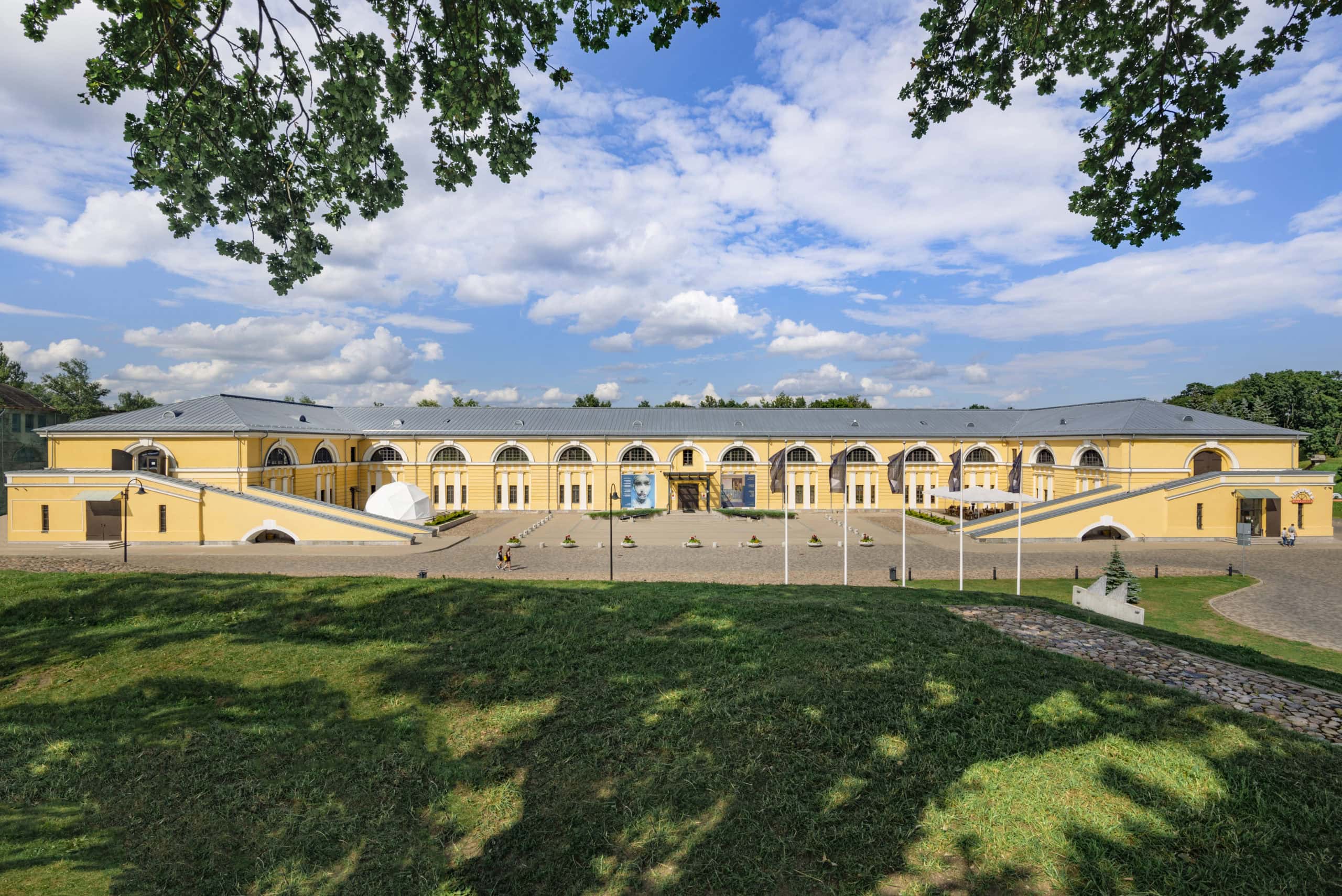
The Artillery Arsenal
Rothko Museum is housed in the historic Artillery Arsenal of Daugavpils Fortress, an architectural monument of national significance whose history began almost two centuries before the museum opened.
In 1831, by order of Russian Emperor Nicholas I, plans were drawn up for a new artillery arsenal at Daugavpils Fortress. A site between the Michael and Nicholas Gates was selected, and construction was completed in 1833. Soon afterwards, military equipment was transferred to Daugavpils from the artillery arsenal in Vilnius, while the new building accommodated workshops for the manufacture and repair of artillery equipment and ammunition storage facilities. The two-storey masonry building was constructed in the Empire style, its monumental appearance characterised by a symmetrical composition, rhythmic arrangements of pilasters and niches, rustication and prominent cornices. The arsenal’s interiors are particularly distinctive, with rooms arranged in an enfilade, cross and barrel vaults, and an interplay of light and shadow created by daylight entering from both sides of the building. Its U-shaped layout is complemented by a central projecting section and sloping ramps on the southern façade.
The arsenal retained its original military function until the mid-20th century. After the Second World War, the building came under the administration of the Dvinsk Military Aviation Technical School. In 1948, it was converted into a cadets’ dining hall, while from 1976 to 1993 it served as cadet barracks. Following the military school’s relocation to Russia, the building remained without a permanent use for several years. Gradually, however, culture began to find its way into the former arsenal. The square outside became a venue for public events, while the ground-floor rooms occasionally hosted art and photography exhibitions.
In 2013, the former military arsenal entered a new chapter in its history, this time as an international centre for art.
A Place Where Art Transforms Its Surroundings
The idea of establishing a Mark Rothko art centre in Daugavpils emerged in 2002. At the time, Mark Rothko’s connection to his birthplace – formerly Dvinsk in the Russian Empire, now Daugavpils in Latvia – had received relatively little attention in the international cultural sphere. The vision of creating an art centre dedicated to the artist offered an opportunity to bring this important aspect of his biography into focus while establishing an internationally significant art institution in Daugavpils.
The journey from the initial idea to the museum’s opening took more than a decade. Collaboration with Mark Rothko’s family – his children Kate Rothko Prizel and Christopher Rothko – played a crucial role, alongside the contributions of cultural professionals, institutions and supporters from Latvia and abroad. This cooperation also made it possible to exhibit original works by Mark Rothko from the family collection in Daugavpils.
On 24 April 2013, the Daugavpils Mark Rothko Art Centre opened its doors to the public. A vision nurtured for more than a decade had become an international art institution, highlighting Mark Rothko’s connection to his birthplace and creating new opportunities for Daugavpils to engage with the art scenes of Latvia, Europe and the wider world.
The idea of establishing the Daugavpils Mark Rothko Art Centre first emerged.
Extensive international events were held in Daugavpils to mark the centenary of Mark Rothko’s birth. A gallery displaying reproductions of Rothko’s works was established at the Daugavpils Local History and Art Museum, while a memorial entitled “Dedication to Rothko”, created by artist Romualds Gibovskis, was unveiled on the banks of the River Daugava.
Cooperation was established with Mark Rothko’s children, Kate Rothko Prizel and Christopher Rothko, who expressed their willingness to loan original works by the artist and became actively involved in establishing the Daugavpils Mark Rothko Art Centre. They also became co-founders of the Mark Rothko Art Centre association.
The first international Mark Rothko painting plein air was organised, marking the beginning of the art collection for the future Rothko Centre.
The general concept for establishing the Daugavpils Mark Rothko Art Centre was developed, and confirmation was received that original works by Mark Rothko would be made available on an indefinite loan.
A project implementation unit for the Daugavpils Mark Rothko Art Centre was established within the Cultural Department of Daugavpils City Council, and the centre’s technical design was commissioned by the municipality.
The book-catalogue Rothko in Daugavpils was published.
The operational strategy of the Daugavpils Mark Rothko Art Centre for 2013–2017 was developed and approved.
In May, reconstruction work began on the historic Artillery Arsenal, the future home of the Daugavpils Mark Rothko Art Centre.
At the end of the year, the reconstructed Artillery Arsenal building was officially commissioned.
On 24 April, the Daugavpils Mark Rothko Art Centre was officially inaugurated in the presence of the artist’s children, Kate Rothko Prizel and Christopher Rothko. For the first time, six original works by Mark Rothko from the family collection were exhibited in Daugavpils. This marked the beginning of a long-term partnership with the Rothko family, with the selection of original works scheduled to change every three years.
The Rothko Centre became a member of the Latvian Museum Association.
On 24 April, a new selection of original works by Mark Rothko from the family collection was unveiled, continuing the three-year exhibition cycle established in 2013.
In spring, a work by Edvard Munch, “Portrait of the Lawyer Ludvig Meyer”, from the collection of Trondheim Art Museum in Norway, was exhibited in Latvia for the first time.
On 12 July, the third exhibition of original works by Mark Rothko from the family collection opened in the presence of the artist’s daughter, Kate Rothko Prizel.
In July, the exhibition “The Wonderful World” by American artist Hunt Slonem opened, marking the artist’s first exhibition in the Baltic region.
In April, the Rothko Centre opened its first collection exhibition, “Discovered in the Collection”. The extensive exhibition offered a visual overview of the artistic and cultural treasures accumulated over nine years of activity.
On 22 April, the Rothko Centre gained a new exhibition space with the opening of Martinsons House in the historic gunpowder magazine of Daugavpils Fortress. Conceived as a tribute to the outstanding Latvian ceramic artist Pēteris Martinsons (1931–2013), it became a permanent home for his artistic legacy.
On 18 April, the fourth exhibition of original works by Mark Rothko from the family collection opened in the presence of the artist’s daughter, Kate Rothko Prizel. To mark the Rothko Centre’s tenth anniversary, she donated two drawings from Rothko’s early artistic period to the centre’s collection.
On 8 September, an open storage facility housing the Rothko Centre’s contemporary ceramics collection opened in the casemates of the seventh bastion of Daugavpils Fortress.
On 1 October, the Daugavpils Mark Rothko Art Centre officially became Rothko Museum, marking a new chapter in the institution’s development.
On 13 May, Christopher Rothko visited Rothko Museum while travelling to Oslo for the opening of the exhibition Mark Rothko: Paintings on Paper at the National Museum of Norway.
In September, Rothko Museum marked the centenary of Surrealism with “Disegno Interno: Surrender to Your Obsessions”, a retrospective exhibition of the legendary Czech filmmaker Jan Švankmajer and his wife and creative collaborator Eva Švankmajerová.
On 19 December, Rothko Museum curator Farida Zaletilo was awarded a lifetime grant by the State Culture Capital Foundation in recognition of her outstanding contribution to Latvia’s international cultural profile and the development of its cultural landscape. Her work on the “Rothko Project” culminated in the establishment of Rothko Museum and the presence of original works by Mark Rothko in the artist’s birthplace.
Daugavpils Museum and the Creative Crafts House became part of Rothko Museum’s organisational structure, expanding the scope of the museum’s activities.
On 24 April, the fifth exhibition of original works by Mark Rothko from the family collection opened.