Wonkun Jun. Semantics of Layers
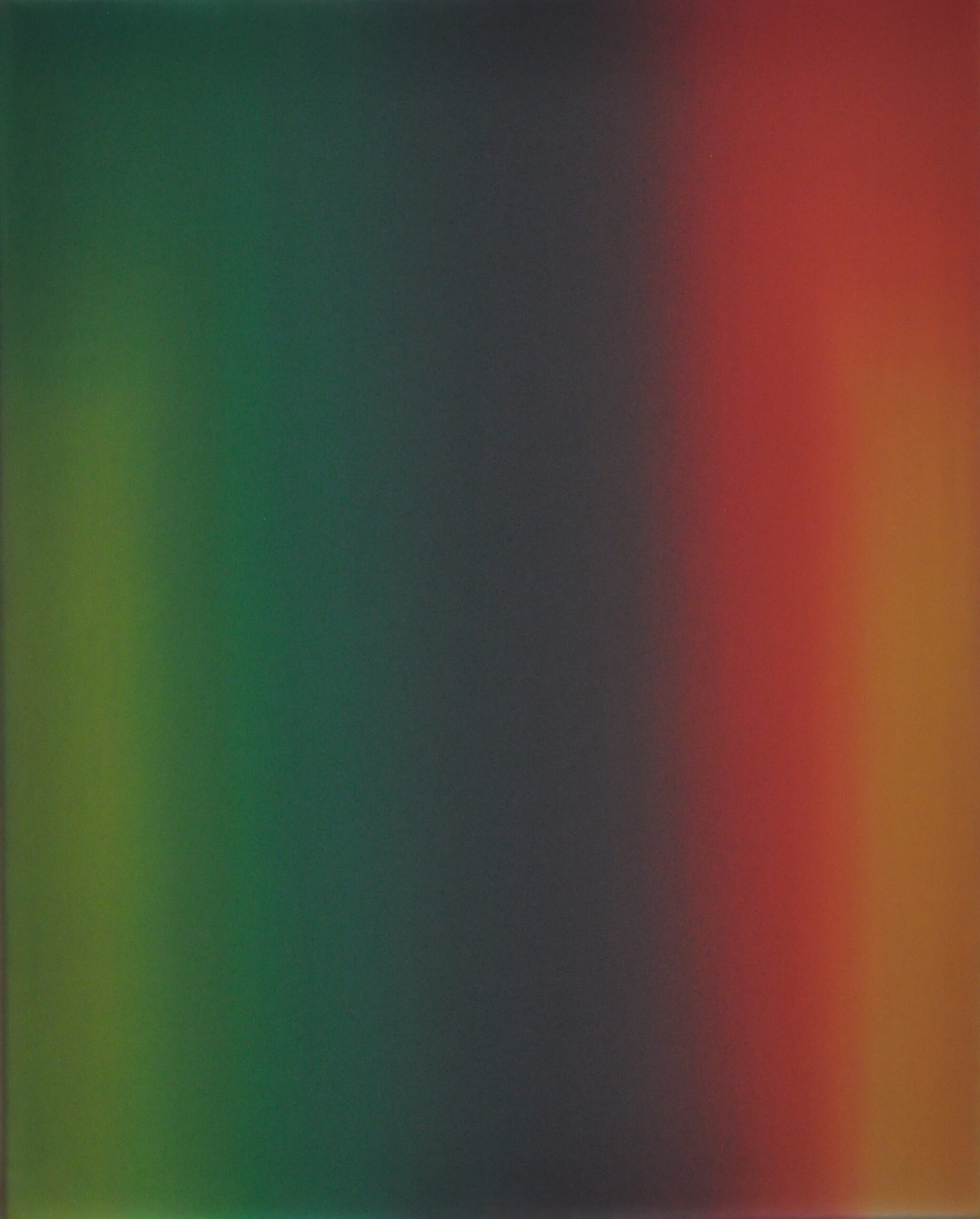
Wonkun Jun “Untitled” (2025–2026). Acrylic on canvas, 100 x 80 cm
In painting, each layer of colour transforms what lies beneath – concealing, enriching or changing the meaning of what came before. Yet the earlier layers never disappear entirely. They remain part of the painting’s structure, shaping what we see on the surface. This interplay lies at the heart of South Korean artist Wonkun Jun’s work. His deceptively simple compositions, dominated by restrained fields of colour and barely perceptible geometric forms, hold far more complexity than first meets the eye. Rather than reducing painting to a limited set of visual elements, Jun explores how much meaning a seemingly minimal image can contain.
Jun’s working process is painstaking and precise. Forty, fifty or sometimes more layers of thinly applied paint build up a surface where each new application changes how we perceive those beneath it. Working with a limited palette of primary colours, he achieves subtle tonal variations that often resist easy definition. Each layer carries traces of the creative process – the time spent on the painting, the rhythm of repetition, the artist’s decisions and the changes that occur between successive applications of paint. What we see on the surface is merely the final stage of this process, not its complete record. The tension between everything a painting contains and what it allows us to see gives Jun’s work much of its distinctive character.
Art critic Lee Seonyoung observes that time matters more than space in Jun’s painting. This insight captures his approach to painting as the outcome of a sustained process. A sense of depth emerges through variations in colour density, transparency and gradual tonal shifts. What initially appears to be a uniform field reveals an intricate internal structure on closer inspection. Jun deliberately avoids an immediate visual impact, inviting viewers to slow down and adjust their pace of looking. In today’s visual culture, where images often compete for our attention through immediate visual impact, this approach carries particular significance.
For all its abstraction, Jun’s painting remains rooted in the physical world. Shifting light, atmospheric conditions and the ageing of materials all inform his artistic interests. Historical objects and traditional Korean ceramics hold a particular fascination for him. The subtle tones of historic glazes and the changes they undergo over centuries reveal how materials preserve the traces of time. Jun translates this interest into painting, not by reproducing the forms of historical objects but by exploring the processes that shape their appearance. His layered surfaces thus bring together two different expressions of time – the patina that develops naturally over centuries and the gradual, deliberate construction of a painting.
Composition plays an equally important role in Jun’s work. Softly defined circular forms, vertical rhythms and almost imperceptible transitions of colour suggest that the image extends beyond the edges of the canvas. Elsewhere, the centre remains nearly empty, while visual intensity gathers around the margins. Such arrangements challenge conventional distinctions between the compositional centre and the periphery. Jun draws attention to elements that might otherwise go unnoticed. His restraint is a deliberate artistic choice, encouraging us to reconsider what gives an image its visual and expressive significance.
Wonkun Jun’s solo exhibition at the Rothko Museum marks his second encounter with Daugavpils. In 2013, he took part in the museum’s international Mark Rothko Painting Symposium, and his return thirteen years later offers a new perspective on this connection. Colour takes on a significance of its own in the work of both Mark Rothko and Wonkun Jun, although their approaches differ. Where Rothko’s colour fields convey emotional intensity, Jun builds a subtle tonal language through the gradual accumulation of paint. For both artists, the meaning of a painting extends beyond its visible form. In Jun’s work, however, the act of painting itself takes on particular importance – the time accumulated in successive layers of colour and preserved within the painted surface.
Māris Čačka, curator of the exhibition
Wonkun Jun (b. 1970) was born in Seoul, South Korea. He studied at Chugye University for the Arts in Seoul before continuing his education in Braunschweig and at the Kunstakademie Düsseldorf in Germany, where he trained under Professor Helmut Federle. Jun’s artistic career spans South Korea and Germany, and his painting reflects an interplay between European abstraction and Korean cultural traditions. His work has featured in solo and group exhibitions across Europe and Asia.
Curated by Māris Čačka and Pāvels Terentjevs
Supported by the State Culture Capital Foundation of Latvia and the Daugavpils City Council